Last updated: August 11, 2026
- Phosphorus is not a required nutrient on U.S. food labels, so most packaged foods carry no phosphorus figure.
- Inorganic phosphate additives (found in processed foods) are absorbed at roughly 90–100%, compared to roughly 40–60% for organic phosphorus in whole foods — meaning form matters as much as total milligrams.
- Cow’s milk contains approximately 250 mg of phosphorus per 8 oz serving; unenriched rice milk contains roughly 20–30 mg per serving.
- Phosphate additives appear on ingredient lists as any ingredient containing “phos” — disodium phosphate, sodium tripolyphosphate, phosphoric acid, and others.
- Boiling high-phosphorus vegetables and draining the cooking water can reduce mineral content; this technique does not work on phosphate additives.
- Phosphate binders prescribed by a physician reduce absorption but do not replace dietary management.
- A renal dietitian can model the right phosphorus-to-protein balance for your specific stage of disease and lab values.
Healthy kidneys quietly filter phosphorus from the blood around the clock — until they can’t. Once that filtering capacity drops, phosphorus accumulates. Over time, it pulls calcium from bones and drives cardiovascular complications that are very hard to reverse. If you have chronic kidney disease (CKD), your care team has almost certainly already raised this. What follows is a practical guide to acting on that advice at the grocery store and in your kitchen.
One thing deserves to be said plainly upfront: phosphorus targets are not one-size-fits-all. They shift depending on your stage of kidney disease, your current lab values, and which medications you take. Everything here is general guidance — not a prescription. Talk to your renal dietitian or nephrologist about your own number before changing anything.
Why Phosphorus Behaves Differently From Most Nutrients You Track on a Kidney Diet
Most nutrition labels handle phosphorus poorly, and that gap matters. In the United States, it is not a required label component — so many packaged foods carry no phosphorus figure at all. The National Kidney Foundation and the National Institute of Diabetes and Digestive and Kidney Diseases (NIDDK) both publish guidance on this; they are reliable starting points for the clinical background.
There is also a distinction most generic articles skip entirely: organic versus inorganic phosphorus. Not a footnote. It changes which foods you should cut first.
Organic phosphorus occurs naturally in protein-containing foods — beans, dairy, meat, nuts. Absorption sits in the range of 40–60% for whole foods, though the exact figure varies by food and individual; no single number applies universally. Digestion controls part of that rate, and in plant foods, the presence of phytate slows it further.
Inorganic phosphorus, by contrast, is added to processed foods as preservatives, flavor enhancers, and color stabilizers — ingredients like disodium phosphate, phosphoric acid, and sodium hexametaphosphate. The intestine absorbs this form far more aggressively, approaching 90–100% by most estimates in nephrology nutrition literature. That math stops working fast once you start eating processed food regularly: a modest portion of ultra-processed chicken can hit your phosphorus load harder than a larger serving of a whole food with a comparable database estimate.
Because of that absorption gap, the practical rule is blunt: if you’re going to eat phosphorus-containing food, choose whole foods over processed ones. The phosphorus in a plain chicken breast is less bioavailable than what’s in a fast-food nugget made from the same meat. Scanning ingredient lists for anything with “phos” in the name is often more impactful than obsessing over milligram counts from a food database.
Low-Phosphorus Foods: The Safe Zones
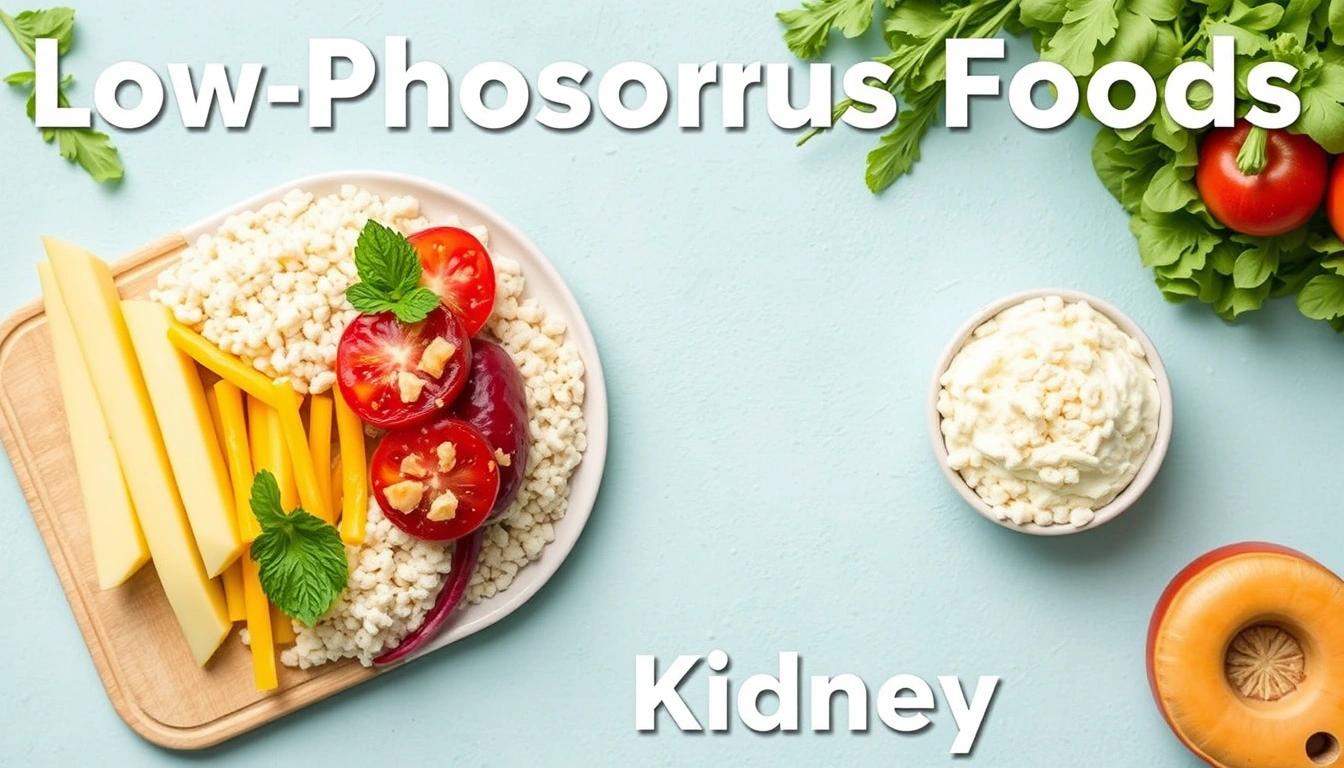
These categories tend to be low in phosphorus and generally appropriate for a kidney diet — though portion size and individual lab targets still apply.
Fruits and vegetables are the most reliable low-phosphorus category. Fresh apples, berries, grapes, pears, and peaches are consistently low — most fresh fruits fall under 30 mg per serving. Green beans, cabbage, cauliflower (about 44 mg per half-cup cooked), lettuce, cucumber, and onions carry modest phosphorus loads on the vegetable side.
Beets, broccoli, and mushrooms land in moderate territory — not forbidden, but worth watching in large quantities. Preparation matters here: boiling and draining off the cooking water (leaching) can cut mineral content further, a technique renal dietitians commonly recommend for higher-phosphorus vegetables.
Refined grains are lower in phosphorus than whole grains — counterintuitive for most healthy-eating advice, but kidney nutrition frequently diverges from general guidelines. White bread averages roughly 25 mg per slice versus about 60 mg for whole wheat. The bran layer is where most of the phosphorus concentrates, so removing it through refining meaningfully reduces the load. White rice and regular pasta follow the same logic.
Egg whites deliver protein with far less phosphorus than the yolk. One large white carries roughly 5 mg; a whole egg sits closer to 95 mg. Honestly, egg whites are one of the more underrated tools for people trying to protect protein intake while staying within phosphorus limits.
Unsalted popcorn runs about 27 mg per 3-cup serving. Rice cakes are similarly low. Both beat crackers, chips, or anything leavened with phosphate-based baking powder.
Some dairy alternatives — unenriched rice milk in particular, at roughly 20–30 mg per serving — sit far below cow’s milk at approximately 250 mg per 8 oz. Check labels carefully, though: certain plant-based milks are fortified with phosphorus, and the inorganic form used in fortification is absorbed efficiently.
High-Phosphorus Foods to Limit or Avoid
These are the categories most commonly flagged in renal dietitian practice.
Dairy products — milk, yogurt, hard cheese, ice cream, cream soups — carry significant natural phosphorus. Hard cheddar, for example, contains roughly 130–145 mg per ounce. Strict portion limits or lower-phosphorus substitutes are standard recommendations.
Dark-colored colas contain phosphoric acid as an additive. Because that phosphorus is inorganic and highly absorbable, cola punches above its weight even in modest amounts — a 12 oz can delivers roughly 40–60 mg of phosphoric acid. Clear sodas generally skip phosphoric acid, though labels still deserve a check.
Processed and packaged meats — deli cuts, hot dogs, sausages, bacon — are treated with phosphate preservatives. Per ounce, the phosphorus content runs meaningfully higher than in unprocessed cuts, and a greater share of it arrives in inorganic form, absorbed more readily. Swapping processed meats for fresh, unprocessed cuts is one of the highest-impact single changes most people can make. Note: dietary changes for kidney disease should be made in consultation with your nephrologist or renal dietitian, as individual phosphorus limits vary significantly by disease stage and lab values. See the National Kidney Foundation for additional guidance on processed foods and CKD.
Nuts and seeds are phosphorus-dense. One ounce of almonds contains roughly 135 mg; peanut butter carries about 100 mg per two-tablespoon serving. Nut butters are no exception.
Whole grains and bran cereals — as established above — concentrate phosphorus in the bran fraction. Oat bran, wheat bran, and whole-grain crackers run significantly higher than refined equivalents; some bran cereals exceed 250 mg per serving.
Beans and lentils are complicated. A half-cup of cooked kidney beans contains roughly 120 mg of phosphorus — but phytate in the beans reduces how much of that is absorbed. Cooking dried beans and then pouring off both the soaking water and the cooking liquid can lower the mineral load further. Even so, the phosphorus burden still warrants portion control in most renal diets.
Organ meats deserve a mention. Liver runs roughly 400 mg per 3 oz serving. Avoid it altogether on a kidney diet.
The Additives Problem: What Ingredient Labels Actually Mean

Phosphate additives get the least attention relative to how much they matter. Here is what to look for on an ingredient list:
- Disodium phosphate
- Sodium tripolyphosphate
- Phosphoric acid
- Calcium phosphate
- Monocalcium phosphate
- Sodium hexametaphosphate
- Pyrophosphate (in any form)
These show up in fast food, frozen meals, canned soups, flavored beverages, processed cheese, commercially baked goods, and many bottled sauces. The last category compounds the problem: a food might show a modest phosphorus figure in a nutrient database — those databases often miss additive phosphorus entirely — while actually delivering a concentrated dose of rapidly absorbed inorganic phosphorus.
The habit shift that matters most: buy plain, single-ingredient foods and cook from scratch as much as is practical. A plain chicken breast has a known phosphorus profile of roughly 220 mg per 3 oz. A breaded frozen patty made from the same bird might contain five different phosphate additives, none of which show up on the nutrition panel.
A Practical Head-to-Head: Food Swap Decisions
| Category | Higher-Phosphorus Choice | Lower-Phosphorus Alternative | Practical Note |
|---|---|---|---|
| Grain | Whole wheat bread (~60 mg/slice) | White bread (~25 mg/slice) | Bran layer holds most phosphorus |
| Dairy | Cow’s milk (~250 mg/8 oz) | Rice milk, unenriched (~25 mg/8 oz) | Check label for phosphate fortification |
| Cheese | Hard cheddar (~135 mg/oz) | Brie or cream cheese (small portion) | Soft cheeses tend lower; still limit portion |
| Protein | Processed deli turkey | Fresh roasted turkey breast (~220 mg/3 oz) | Additive phosphorus removed |
| Snack | Peanuts (~135 mg/oz) | Unsalted popcorn (~27 mg/3 cups) | Nuts are phosphorus-dense |
| Beverage | Dark cola (~50 mg/12 oz) | Lemon-lime soda or water | Phosphoric acid vs. no phosphorus |
| Breakfast | Bran cereal (250+ mg/serving) | White rice cereal or cream of wheat (~40 mg) | Refined grain vs. whole grain rule |
| Condiment | Bottled barbecue sauce | Homemade seasoning | Phosphate preservatives in bottled sauces |
This table reflects general patterns, not absolute rules. Portion size, individual lab values, and preparation methods all affect how a specific food fits your diet on a given day.
What Generic Kidney Diet Articles Get Wrong About Low-Phosphorus Foods
Most lists focus on milligrams per serving and leave the bioavailability dimension out entirely — treating 100 mg of phosphorus in a whole food as equivalent to 100 mg in a processed one. That is nutritionally inaccurate. Nephrology nutrition literature is consistent on this: the form of the phosphorus matters as much as the quantity, because absorption rates between organic and inorganic sources differ dramatically.
Cooking technique is another gap. For high-phosphorus vegetables, boiling in water and then draining it off — rather than steaming or microwaving — is what renal dietitians commonly recommend to reduce mineral load. It does not eliminate phosphorus, but research in nephrology nutrition suggests the reduction in certain vegetables is meaningful. That approach, to be fair, is useless against phosphate additives; no amount of boiling removes what was never in the food’s natural structure.
There’s also a protein trap most articles ignore entirely. Phosphorus and protein often travel together in the same foods. Cutting phosphorus too aggressively without guidance can quietly erode protein intake — which carries its own serious risks for people with kidney disease. Restriction alone does not solve this. A renal dietitian can map the right balance for your stage of disease and your current labs. That conversation is worth having before you make sweeping changes.
FAQ
Can I eat fruit on a kidney diet if I’m limiting phosphorus?
Most fresh fruits are low in phosphorus — typically under 30 mg per serving — and are generally considered appropriate for a kidney diet. The bigger concern with fruit in kidney disease is often potassium, not phosphorus, so check your specific lab results and targets with your care team before assuming all fruit is freely safe.
Is plant-based phosphorus really absorbed less than phosphorus from meat?
The research in this area is ongoing, but the general position in nephrology nutrition is yes — plant-based phosphorus bound to phytate is absorbed at a lower rate than the phosphorus in animal protein, and both are absorbed at a lower rate than inorganic phosphate additives. This is one reason some renal dietitians look favorably at well-planned plant-forward diets for kidney disease, though individual protein needs complicate the picture.
How can I find the phosphorus content of a food if it’s not on the label?
The USDA FoodData Central database (fdc.nal.usda.gov) includes phosphorus values for many foods and is a reliable, free resource. Keep in mind that it may not capture phosphate additive content accurately for packaged foods.
Do phosphate binders mean I don’t need to watch my diet?
Phosphate binders — medications prescribed to reduce phosphorus absorption — work alongside dietary management, not instead of it. Dosing is calibrated to your food intake and lab values. Eating more phosphorus on the assumption the binder will handle it generally does not work cleanly in practice — well, not reliably. Dietary management of low-phosphorus foods remains essential even when binders are prescribed.
Are there kidney-specific cookbooks or resources I can trust?
The National Kidney Foundation and the Academy of Nutrition and Dietetics both publish patient-facing resources on renal nutrition. A registered dietitian who specializes in kidney disease is the most reliable source of personalized guidance — many hospitals with nephrology programs offer renal dietitian consultations.